English version below
Auch dieses Jahr waren wir wieder bei der mit am Start. Diesmal mit einem Redebeitrag zu Queer sein im Knast. #
We took part in the Queer Pride Dresden this year too and held a speech about Queerness in Prison
Queer in Prison…
Piper is imprisoned for 15 months in a women’s prison because of drug dealing and meets her ex, Alex, there. They had lost view of each other, but daily prison life brings them back together. Nicky, who is also in prison for drug dealing, robbery, and housebreaking, loves her fellow inmate Lorna truly and deeply. Sophia, a trans woman serving time in the same prison for credit card fraud, works there as a hairdresser and takes care of her fellow inmates’ hair, while Susanne, who killed her husband, finds love in prison with the butch Walter… Sounds like some pretty nice queer stories in everyday prison life? They are. At least in “Orange Is the New Black” and “Behind Bars: The Women’s Prison.” But on Netflix and RTL, just anything is possible.
But the reality for queer prisoners looks very different. Transgender inmates, in particular, are restricted, harassed, and often punished twice because of their gender. Living out homosexuality in prison is associated with fear, exclusion, violence, and discrimination for prisoners.
But how does it work, to be queer in prison? Who decides which (binary) prison you’re sent to if you’re transgender or non-binary? Is there a right to therapy and hormone treatment?
First things first: As always, it’s complicated, and there’s no uniform policy anyway—everyone does a little bit whatever they want. The placement of queer individuals in the German prison system is a matter for the federal states—meaning each state has its own regulations—and in the end, it usually comes down to a case-by-case decision anyway. The legal gender registration is used as a reference, but security risks, the safety of the person concerned, and the protection of fellow inmates are also factored into the decision regarding which prison a person will serve their sentence in. Of course, this system only works strictly on a binary, two-gender basis. So if a trans woman hasn’t (yet) had her legal gender changed, she usually ends up in a men’s prison. However, this often puts women at risk, and so-called “protective custody” may be ordered, with them being housed in separate areas. Most prisons, though, have only limited space within their inhumane walls. This leads to situations where, for example, trans prisoners end up in isolated custody rather than protective custody. This was—and still is—the case for Maja in Germany and Hungary.
A short note on isolated custody: Technically speaking, isolated custody does not exist in Germany. This is because the Prison Law only regulates the “separation from other prisoners”—that is, individual custody. That sounds much better. It sounds like a private room, privacy, and peace and quiet. It may be imposed for a maximum of 3 months. In practice, however, it is isolated custody, and under international law, isolated custody that lasts longer than 15 days is classified as torture!! The “European Committee for the Prevention of Torture” has long been calling for a ban on it.
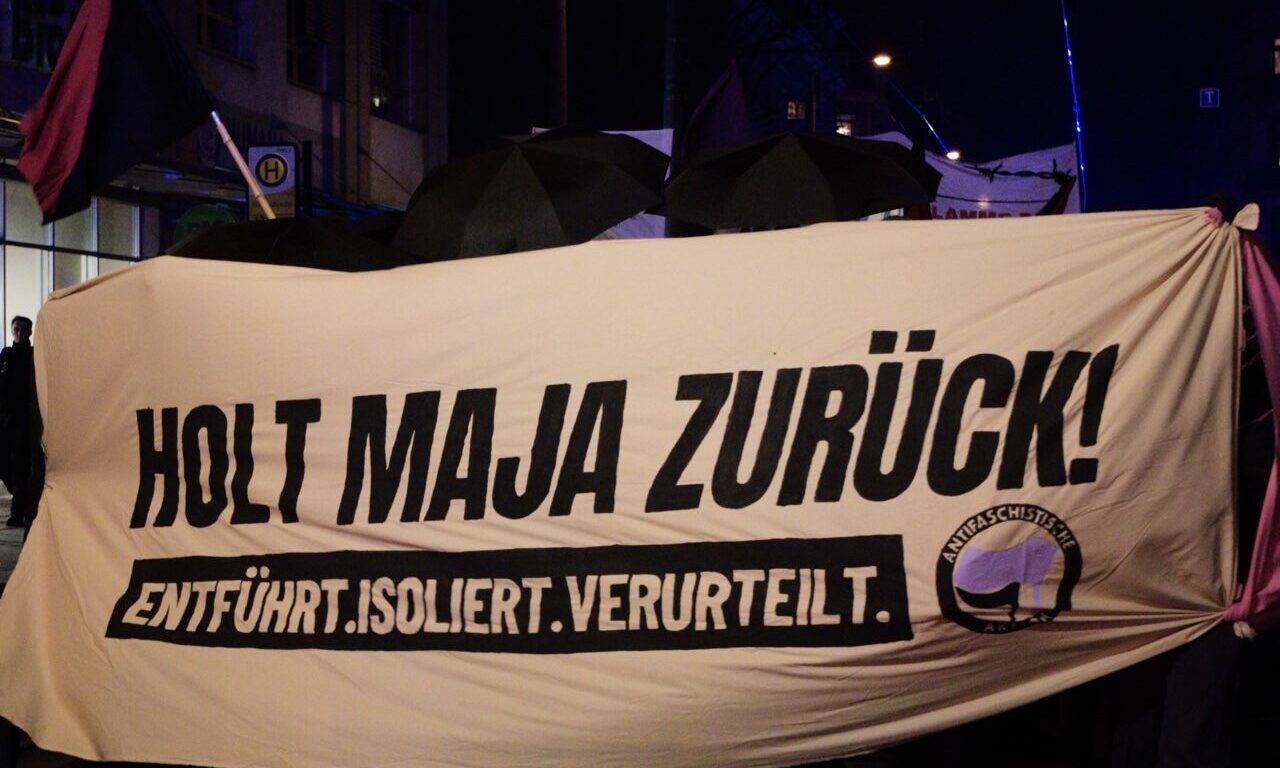
Let’s go back again to Maja for a moment. Maja is a non-binary prisoner in the so-called “Budapest Complex.” Maja was sitting in the Dresden prison and was harassed by other prisoners there in a queerphobic attack. As a result, protective custody (i.e., isolation) was imposed. On June 27, 2024, Maja was unlawfully extradited to Hungary and has been held in isolative custody there again since June 28, 2024—that is, for almost 2 years. That’s 722 days! Alone for 722 days, under video monitoring and constant cell checks. For 707 days, this has officially constituted torture! Because of the terrible conditions, Maja went on a hunger strike for 40 days and was transferred to a prison hospital. Maja reported that conditions were better there. Because Maja could look out of the window, and the hospital staff meant human contact. How sick must a society be to push people to hunger themselves nearly to death, only to then interpret their rescue—which can no longer be postponed—as a “social blessing”? What goes on in the minds of those who push others to take such steps? And then to sell the whole thing as “protection.” The perverse thing about this is that Maja needs this “protection” only because Maja does not even exist in Hungary. After all, queer, trans, intersex, and non-binary people have been denied the right to exist under the Hungarian Constitution.
The Hungarian government is clearly breaking the European Charter of Fundamental Rights. If these are the conditions under which queer and trans people are already living in prison, we have to hope that Magyar keeps his promise and reverses the anti-democratic laws passed under Urban—otherwise, we can only imagine what activists there will face in the coming years.
The Hungarian government is clearly breaking the European Charter of Fundamental Rights. If these are the conditions under which queer and trans people are already living in prison, we have to hope that Magyar keeps his promise and reverses the anti-democratic laws passed under Urban—otherwise, we can only imagine what activists there will face in the coming years. But back to Germany.
What happens when queer people in prison need hormones or therapy? If you’re lucky, you’ll have already been getting hormones prescribed by a doctor before your sentence began, then you’ll need to continue that treatment in prison. And in most cases, that’s possible. After all, the so-called “equivalence principle” says that medical care in prison must be equivalent to that received outside of prison. Requests for doctor visits outside the prison can be denied or lie for ages in the “to-be-processed” box in the prison administration’s office. If this is already the case for binary transgender people, what does it look like for non-binary prisoners – those who have a diverse gender entry or none at all? Prisons have had little experience with this so far. The Dresden prison, for example, handles this on a case-by-case basis and refers to its “house rules.” We can imagine what such a case-by-case decision by prison administration looks like: physical norms are used to determine who corresponds to which binary gender and which prison they’ll be sent to. But prisons, by their inherent nature, have nothing to do with self-determination, and so the SBGG is worthless when it comes to sentencing people to prison.
That’s why the following principle still holds true:
Anyone who stands up against the fascistization of society today must also expect to be targeted by the authorities.
To attack the problem and find a solution means grabbing it by the roots: Prisons must be abolished! Turn prisons into buildings lots, and buildings lots into community gardens.